
Gentle Alternative to String Floss: What to Do When Flossing Hurts Your Gums and Makes Them Bleed?
- Marc The Dental Shaman

- Dec 3, 2025
- 8 min read
If string floss hurts your gums or makes them bleed, you are not alone.
In my clinic, this is one of the most common complaints I hear.
Many people have been told that “a bit of bleeding is normal” when you floss. But in most cases, that is not true. Persistent bleeding is a sign that something in the mouth or body is not happy.
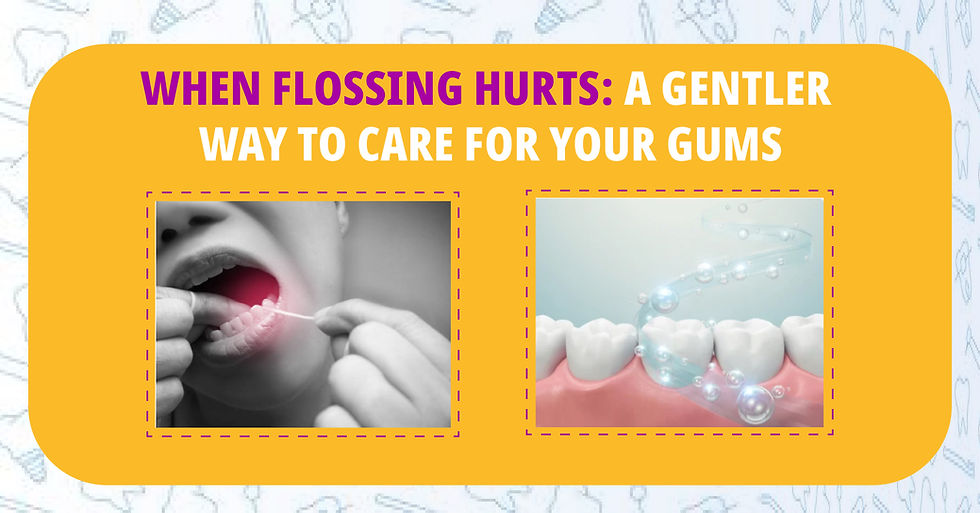
In this post I will answer this question from my own clinical experience of over 40 years in dentistry and holistic oral health. I will walk through:
How often I see this problem?
Why string floss so often causes pain and bleeding?
Who struggles the most?
What gentler alternatives I use in practice?
Real cases where bleeding stopped after changing methods?
How this links to your general health?
My aim is simple: clear, honest guidance that respects your gums, your nervous system, and your whole body.
1. How often do people complain that floss hurts or makes them bleed?
Very often.
If I look at a typical week in practice, I hear some version of this almost every day:
“Flossing always makes my gums bleed.”
“I try to floss but it hurts, so I stop.”
“My gums are too sensitive for floss.”

Many people believe this is just how flossing feels. But health services are clear that bleeding gums are one of the main signs of gum disease, not a sign that you are “doing a good job.”
The NHS, for example, lists bleeding when you brush or floss as a key symptom of gum disease. You can Explore this NHS guide to know more ..
So, when someone tells me their gums always bleed with string floss, I do not see that as normal. I see it as information. The tissue is inflamed, fragile, or being traumatised.
Bleeding is the body’s way of asking for a different approach.
2. Why does string floss cause pain and bleeding?
In my experience, the most common reason is a combination of:
Inflamed, fragile gum tissue
Forceful or rushed technique
A dry or acidic mouth
Stress and tension in the body

People are often taught to “get right under the gum” with floss. They slide the floss down and then push or snap it into the gum. Many then saw back and forth with more force than they realise.
If the gum tissue is already irritated by plaque, acidity, mouth breathing, or bacterial imbalance, it does not take much to make it bleed. Even what feels like light pressure can be too much for tissue that is thin and inflamed.
So the problem is not only the floss. It is the mix of:
Sensitive tissue
Hard material (string)
Strong or clumsy movement
A stressed nervous system behind the hand
If you add in a dry mouth, the risk of trauma goes up again. Dry tissue tears more easily.
3. Who struggles the most with string floss?
I see problems with string floss across many groups, but four stand out.
People with active gum disease:
If you have gingivitis or periodontitis, the gums are already inflamed. They are swollen, more fragile, and full of tiny blood vessels. Pushing string into that tissue can easily cause bleeding and soreness.
Professional bodies like the British Society of Periodontology describe bleeding gums as a sign of gum disease, and encourage better cleaning, not more trauma.

Implant patients:
Around implants, the soft tissue is precious. Inflammation here can lead to bone loss and implant failure if ignored. String floss can cut or saw into this delicate area, especially if it wraps around the implant in a “cheese wire” effect.
People with braces or retainers:
Brackets, wires, and fixed retainers make access difficult. People get frustrated. They pull harder. They rush. The floss catches, then releases, and snaps into the gums.
Those with naturally thin or sensitive gums:
Some people simply have a thin gum biotype. The tissue is fine and fragile. In these mouths, harsh string flossing often causes repeated micro-trauma instead of healing.
For these groups, a different approach is usually kinder and more effective.
4. What gentler alternatives do I use and recommend?
Over the years, I have tried many methods in real mouths. I always come back to gentle alternatives to string floss that clean well without stressing the gums or the nervous system.
The goal is simple. Clean without causing harm.
Here are the main gentle alternatives I use and trust-
Water-based interdental cleansing:
This includes water flossers and other devices that send a focused stream of water between the teeth.
When used with care, they can:
Flush out food and plaque
Massage the gums
Reach into spaces where floss struggles

Research suggests that adding interdental cleaning to toothbrushing helps reduce gum inflammation compared to brushing alone, and interdental brushes may be more effective than floss in some cases.
More recent studies also show that water flossers can reduce plaque more than string floss in some situations, especially in areas that are hard to reach.
If you want to look at the evidence, you can read a clear summary on the Cochrane Oral Health site about floss, interdental brushes, and other cleaning tools: Home use of devices for cleaning between the teeth. Cochrane
Interdental brushes:
Where space allows, small interdental brushes can be kinder and more effective than floss. NHS guidance for gum health notes that interdental brushes are often the first choice for people with gum disease or larger spaces between teeth.
The key is to choose the correct size and avoid forcing them. When matched properly, they glide through with gentle resistance, not pain.
An accessible guide to floss and interdental brushes is here: Guide to dental floss and interdental brushes – Haynes Dental. haynesdental.co.uk
Ozone water flushing:
In a biological setting, I will often use ozone-infused water for flushing around teeth and gums. Ozone has antimicrobial effects and can help calm inflamed tissue when applied in a controlled way, though it is not a standard NHS treatment and needs proper training and equipment.
My observation over many cases is that:
The gums look calmer
Bleeding reduces more quickly
Patients report less soreness
This is clinical experience rather than large-scale trial data, so I present it as that: what I have seen again and again in my own patients.
Soft rubber-tipped stimulators:
These tools can gently massage the gum line and help remove soft plaque without cutting into the tissue. For some very sensitive patients, they are a good starting point before moving on to more direct interdental cleaning.
Breath, hydration, and saliva support:
None of the tools above work well if the mouth is dry and acidic. Saliva is one of the body’s main natural defences. Good hydration, nasal breathing, and a balanced diet support saliva flow and quality.
So in my clinic, I never talk about tools alone. I always link them to:
How you breathe
How much and what you drink
How stressed your system is
Calm, moist tissue responds very differently to cleaning compared to dry, stressed tissue.
5. Which gentler options work best long term?
If I had to pick one approach that has given the most consistent results over time, it would be:
Water-based interdental cleaning + good hydration + nasal breathing + saliva support.
On top of this, I add:
Interdental brushes where anatomy allows
Ozone water in appropriate clinical settings
Studies comparing water flossers with string floss suggest that water flossing can remove plaque at least as well, and in some cases better, particularly in difficult-to-reach areas and around fixed appliances.
Evidence summaries like the one from Cochrane show that interdental cleaning (floss or brushes) in general is helpful for reducing gum inflammation when added to brushing.
Clinical evidence has its limits, but when I combine those findings with what I have seen in practice, the picture is clear:
Gentle, water-based and brush-based cleaning, supported by a healthy oral environment, gives calmer and more stable gums over time than harsh string flossing.
6. Real cases: what happens when people switch from string floss?
I have seen many versions of the same story. Here is a typical pattern (details altered for privacy, but the pattern is real).

A patient in their 40s comes in.
They say:
“My gums have bled for years when I floss.”
“I try for a few days, it hurts, so I stop.”
On examination:
Generalised redness along the gum line
Bleeding on probing between many teeth
Tight contacts between some molars
Mouth breathing at night, dry mouth in the morning
We agree a new routine:
Switch from daily string floss to a water flosser used gently, once a day.
Add small interdental brushes where there is space.
Focus on nasal breathing, especially at night.
Increase plain water intake through the day.
Receive gentle professional cleaning and, where appropriate, ozone water flushing.
At the next visit, usually 3–6 weeks later, I often see:
Far less bleeding on probing
Healthier colour and tone of the gums
The patient reporting less soreness and more willingness to clean daily
This pattern is not rare. It is common when we remove the daily trauma and support the tissue to heal.
7. Common mistakes when trying to floss “gently”
Many people tell me, “I am already gentle.” When I watch them, I often see the same mistakes:
Still using more pressure than they realise
Snapping the floss into the gum, even slightly
Flossing in a very dry mouth
Rushing, especially late at night
Holding their breath or clenching their jaw
There is also a mindset issue. If you see flossing as a chore or punishment, your body tends to tighten. Tight shoulders, tight jaw, tight hands. That tension flows straight into the gum line.
You cannot be truly gentle if your nervous system is in fight-or-flight mode.
Sometimes the first step is not “better technique.” It is slower breathing, softer shoulders, and a different attitude to your own body.
8. Are there times when I still recommend string floss?
Yes, there are situations where string floss is still useful. I am not “anti-floss.” I am against blind, painful flossing that ignores biology.
I still use or recommend string floss when:
There are very tight contact points that water or brushes cannot reach
A specific area needs close mechanical cleaning under guidance
The patient is able and willing to learn a softer, precise technique
But even then, I set clear conditions:
The floss must slide, not snap.
Movements must be slow and controlled.
There should not be repeated bleeding in the same area week after week.
If discomfort continues, I see it as a sign to reassess, not a reason to push harder.
9. What does bleeding during flossing say about your body?
From a holistic and biological view, bleeding gums are rarely only a local issue. They are a local expression of a wider pattern.

Possible contributors include:
An acidic oral environment
Low saliva flow or poor saliva quality
Chronically high stress
Mouth breathing, especially at night
Nutritional gaps (for example, low vitamin C, D, or other micronutrients)
Broader inflammatory tendencies in the body
Mainstream health organisations now acknowledge the link between gum disease and wider health, including diabetes and cardiovascular disease.
You can read more about symptoms and risks here:
Bleeding gums are not a reason to panic, but they are a reason to pay attention. The gums sit at the meeting point of digestion, immunity, and the nervous system. When they bleed easily, they are often reflecting disturbance in that shared space.
My view on flossing and bleeding gums comes from more than four decades in dentistry and holistic oral health.
Over that time I have worked across:
Conventional dentistry
Biological and ozone-based dentistry
Non-toxic materials and methods
Breath-based, nervous-system-aware oral care
My focus has always been on long-term tissue health, not just short-term cosmetic results.
I read the research. I also listen deeply to what actual mouths show over years:
Which gums stay stable
Which approaches people can stick to
Which habits lead to calm tissue versus constant inflammation
So when I say that persistent bleeding with string floss is not “normal” and that gentler alternatives can help, I am not speaking from theory alone. I am sharing what I see again and again in real people.
So, is there a gentler alternative to string floss?
Yes. In many cases, there are several.
If string floss hurts your gums or makes them bleed:
Take it as information, not failure.
Ask a dentist or hygienist to check for gum disease.
Explore gentler options like water-based cleaning and interdental brushes.
Support your mouth with better hydration, nasal breathing, and a calmer nervous system.
Use string floss only where it truly helps, and only with very soft technique.
Bleeding is not a badge of honour. You do not need to injure your gums to care for them.
A healthy mouth feels calmer, cleaner, and kinder than that.


Comments